Internal Agency Reviews in the Federal Budgeting Process
The annual process of funding the government is a monumental task, and staying on top of the many moving parts can be complicated and time intensive. To assistance y'all make sense of how the federal budget is determined, we pause down the theoretical timeline, explain the significance of each step, and highlight how details of the federal budget impact state budgets.
2022 Congressional Calendar
Easily track when the House and Senate are in session with our 2022 combined congressional calendar, available for download now.
How does the federal budget procedure work?
The federal upkeep process typically consists of 7 steps, outlined in greater detail beneath:
- President's budget request
- Budget resolution
- Appropriations bills
- Dominance bills
- Revenue measures
- Budget reconciliation
- Debt limit legislation and raising the U.Southward. debt ceiling
i. President'south upkeep asking
Early each twelvemonth, the White House proposes the level of spending for federal agencies and programs. Information technology outlines estimates for revenue and expenditures and details the administration's policy and spending priorities.
two. Budget resolution
The budget resolution is a blueprint that takes a holistic approach to spending, revenue, and the resulting deficit or surplus to govern internal decision-making. The resolution is without forcefulness of law, and it doesn't become to the president. Lawmakers have frequently skipped this footstep in recent years, instead working out a serial of two-year deals that increased spending caps that had been set by police. The Senate didn't prefer budget resolutions for financial years 2011 through 2013. The House didn't prefer a upkeep resolution for fiscal year 2011. And in FY 2017, the resolution was adopted in Jan, four months into the FY.
3. Appropriations bills
Federal agencies receive funding for a fiscal year through appropriations bills passed by Congress based on the president'south recommendations and Congressional priorities.
What occurs during the appropriations process
The Firm and Senate appropriations committees are divided into 12 subcommittees, which hold hearings to discuss budget requests and needs. Each subcommittee comes up with a bill that must pass both chambers and be signed by the president to take effect. If a full-year cribbing isn't in identify past October. 1, the start of a financial year, a standing resolution can be used to extend funding for a menstruum of time, typically at the previous year's level.
Congressional Appropriations Panels split jurisdiction among 12 Subcommittees.
4. Authorization bills
Authorisation measures are used to create departments, agencies, and programs; set rules for how they're operated; and ready funding levels. Some authorisation bills provide funding for i or more years without farther action, known as a mandatory program. Nigh authorizations crave congressional appropriations action and are referred to as discretionary.
five. Revenue measures
Congress doesn't have to human activity each year on a measure raising revenue. Some tax laws are permanent, while others take expiration dates that crusade Congress to revisit tax rates, credits, and other rules.
6. Budget reconciliation
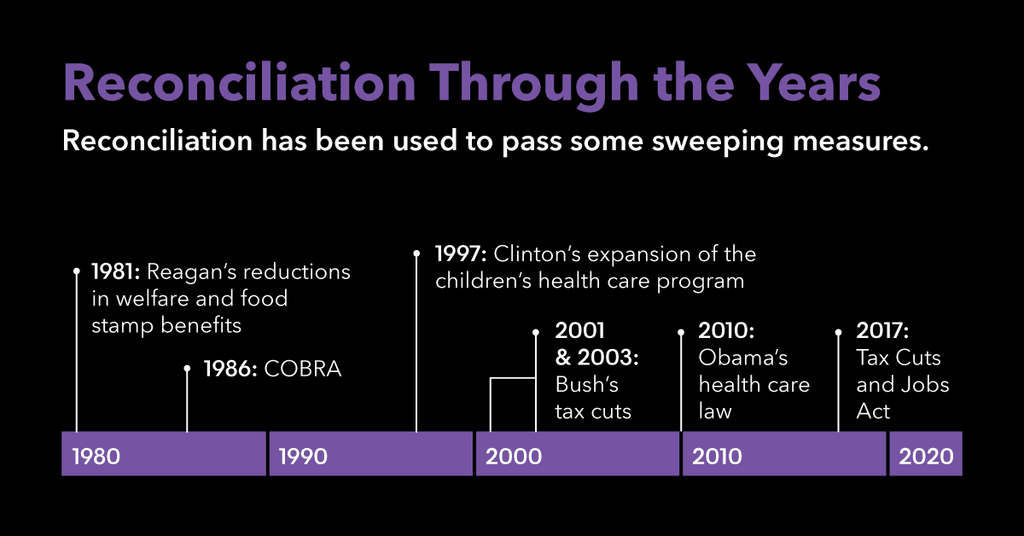
The reconciliation procedure was created past the Congressional Budget Act of 1974. It allows lawmakers to advance spending and tax policies through the Senate with a simple majority.
How the budget reconciliation process works
Budget resolutions tin can include instructions to committees to written report reconciliation legislation, often with a deadline, to meet spending and revenue targets.
The reconciliation instructions also can require reporting of debt-ceiling legislation, which tin come in handy considering of the uncomplicated majority gene.
If more than than one committee receives instructions, then the private committees first transport their recommendations to the House and Senate Budget committees, which consolidate the proposals. If a unmarried committee receives instructions (for example, just the Business firm Ways and Means Committee on a revenue measure), its recommendation can be sent directly for a flooring vote.
Senate debate time limits
In the Senate, fence is limited to 20 hours, meaning the measures can't be filibustered. Proponents also simply need a simple majority rather than the 60-vote supermajority that applies to most legislation nether the bedchamber'south cloture rules – if anybody shows upward, that means 51 votes.
These details make reconciliation bills an bonny target for policy changes that have a budgetary effect (such as health care programs).
7. Debt limit legislation and raising the U.S. debt ceiling
The federal government has a cap on how much debt can be incurred by the federal government. Congress considers legislation to either increase the dollar corporeality in law or, more recently, to append the debt limit for a period of time to allow the government to take steps to finance the deviation betwixt the amount of revenue brought in and the amount of spending required by police force.
Subscribers Only: Congress Clears $1.five Trillion Fiscal 2022 Omnibus
The sweeping parcel included $13.6 billion in emergency funding for Ukraine and other provisions related to cyber incident reporting, Violence Confronting Women Act programs, intelligence authorizations, and foreign policy.
What is the federal budget timeline?
Months of backside-the-scenes work precedes the publication of the president's budget request. During the summertime, agencies work on the budget request for the year after next. For example, in summer 2022, agencies will work on the financial 2024 request. Then agencies send their requests to the Office of Management and Upkeep in the fall. (Note: the Section of Defence typically sends its request to OMB weeks or months after other agencies.)
The White Business firm negotiates final numbers with agencies to reflect its priorities and ensure the totals fit inside budget caps. These numbers are finalized at the terminate of Dec or early January in a typical twelvemonth, or during the spring for a new administration.
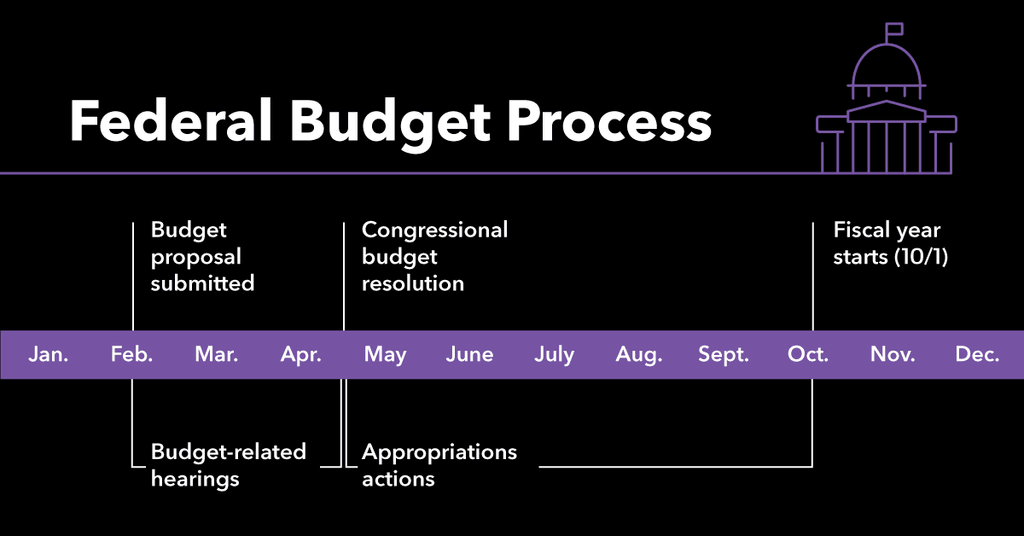
1. President's upkeep request (first Monday in February)
A detailed request for each section and agency. The law requires submission, but at that place is no penalty for being late. The president'southward upkeep request timing is typically delayed in a new administration. For instance, President Joe Biden released his commencement budget request on May 28, 2021, and the request for FY2023 on March 28, 2022.
two. Congressional hearings (Feb – leap)
Agency officials testify earlier authorizing and appropriating committees in lodge to justify budget requests. This offers a preview of the major spending and policy debates.
3. Upkeep resolution (April xv)
Sets acquirement and spending targets for legislation. There is no penalization for beingness belatedly, or even for declining to adopt a budget resolution, and no role for the president.
4. Appropriations bills (Sept. xxx; financial twelvemonth starts Oct. 1)
Twelve measures funding federal agencies and programs. Congress has non completed this piece of work on time since 1997.
five. Continuing resolution (just if necessary)
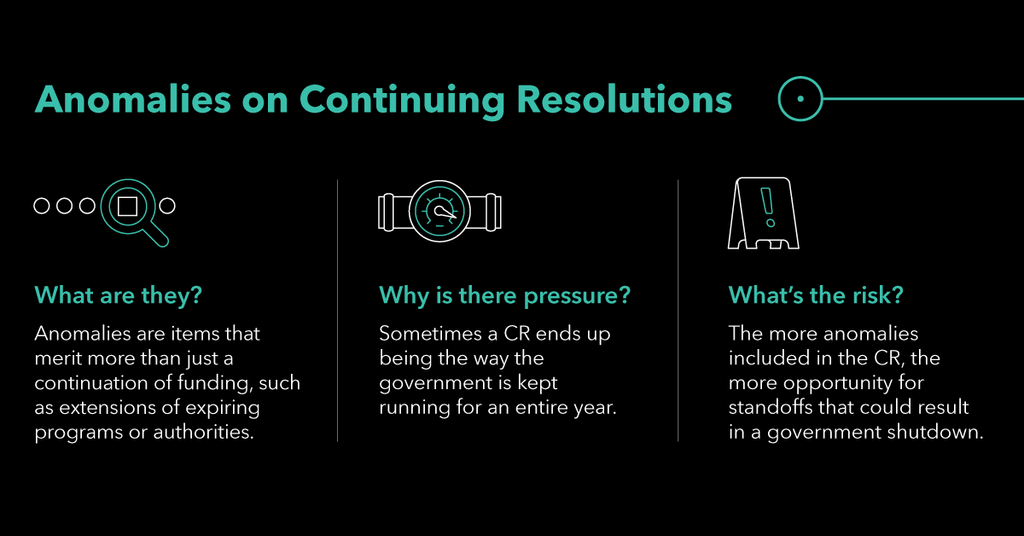
Maintains funding based on the current rate to prevent a lapse in spending. Anomalies provide spending adjustments Lawmakers averted a regime shutdown at the end of 2021 by passing a CR on Dec. two.
Webinar: What'south Next for Congress?
Our analysts gear up the phase for the rest of the yr on Capitol Hill, leading a discussion on the status of key legislative priorities for 2022 with an eye on what tin be achieved before the midterm elections.
How does the federal upkeep affect state budgets?
Historically, federal funds accept made up about a quarter to a tertiary of state revenue. In contempo years, that number has remained close to a tertiary. In most states, the bulk of federal grant money goes toward Medicaid and other health programs and services. Medicaid increases have been a significant driver in an increase in federal funding to states.
Medicaid falls under mandatory spending, every bit do programs such equally Temporary Assist for Needy Families (TANF), SNAP, adoption and foster care programs, and kid diet programs that provide meals to low-income students in school. Examples of discretionary funding to states include Title I funds for high-poverty schools, Caput Start, and public safety grants.
Different the federal authorities, states have balanced upkeep requirements. This means incertitude or a delay in the federal upkeep can have significant consequences for states, given how much of their revenue depends on federal funds. For example, Covid-19 placed an unexpected strain on land finances as they grappled with the economic fallout of the pandemic. This caused declines in country revenues that needed to be counterbalanced by more than federal assistance, and/or spending cuts.
Source: https://about.bgov.com/brief/your-guide-to-navigating-the-federal-budget-process/
0 Response to "Internal Agency Reviews in the Federal Budgeting Process"
Post a Comment